


Release time:2026-01-26 Browsed0 order
There is a detail that may be found by all users: the transmission distance of the Internet of Things wireless module is often an interval,
rather than accurate to a numerical value. Why is this?
In fact, the truth is very simple, the transmission distance of the wireless module is often affected by various factors. In different
environments, weather and stages, the transmission distance will be different.
If a wireless module can transmit 5km under normal conditions, when it is arranged in the case of frequent interference or bad weather,
the transmission distance may not reach 5km.
So, how can we make the wireless module can be applied to a variety of environments, to ensure a safe and stable transmission of data
to our target device? What is co-channel interference?
1. Host polling mode
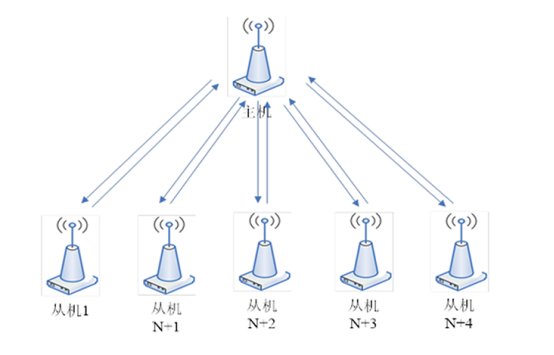
Host polling is the host one by one polling call way, the principle is very simple, through the way of roll call to achieve the answer. If the
host sends to the No. 1 slave machine, because the slave machine has the address set, so only the slave machine 1 can respond to the
host. After receiving the command from the host, slave 1 uploading the data to the host. The host then polls other slave data in the
same polling way. To use an appropriate metaphor, when the teacher (the host) is in class, the number 1 student (the slave) is tapped
to answer the question, at this time only the number 1 student can answer the teacher's question. This is how the host polling works.
The advantage of the polling method is that conflicts are not easy to occur between devices and the network is more stable, but the
disadvantage is that the host polling takes a long time. This networking method is suitable for those networking applications with low
time requirements.
2. The slave machine uploads at regular time
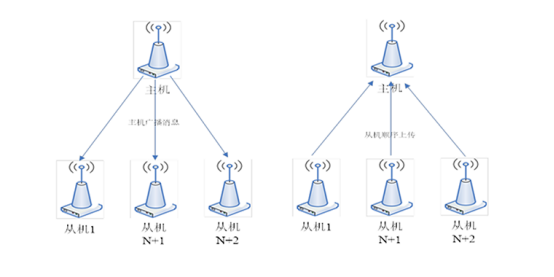
The principle of the timing upload method is that the host broadcasts and sends information to the slave, and the slave receives the
information from the host, synchronizes the time, and then uploads according to the time we set, such as: after the host sends the
information, the upload time of slave 1 is 1 second, then the upload time of slave 2 is 2 seconds... And so on, for example: when we
military training, the instructor issued a command to us, we need to count, from left to right, then the first person on the left to
count the number of 1, the second person is 2, and so on. The principle of timing upload is also the same, set the upload time of
the slave machine, avoid uploading data at the same time, so as to avoid the purpose of interference with the same frequency.
3. The active upload method of the slave machine
The active upload of the slave and the networking method of the LoRa module with its own RSSI function are relatively reliable
active upload methods. This transmission method detects the RSSI signal strength in the environment when the slave needs to
upload data. If the RSSI strength in the current environment is large, it waits for the RSSI value to become small before actively
uploading. Whether the upload is successful or not, the master will feed back to the slave, and decide whether to upload again.
However, this method is not suitable for LoRa modules without RSSI function, because the more frequent the transmission from
the machine, the higher the probability of communication failure, that is, we say the same frequency interference.
To sum up the above three ways, all adopt the principle of staggered upload time from the computer module, so as to solve the
problem of interference with the same frequency.


